Method
IndustRoPose: Real-Time 6D Pose Tracker
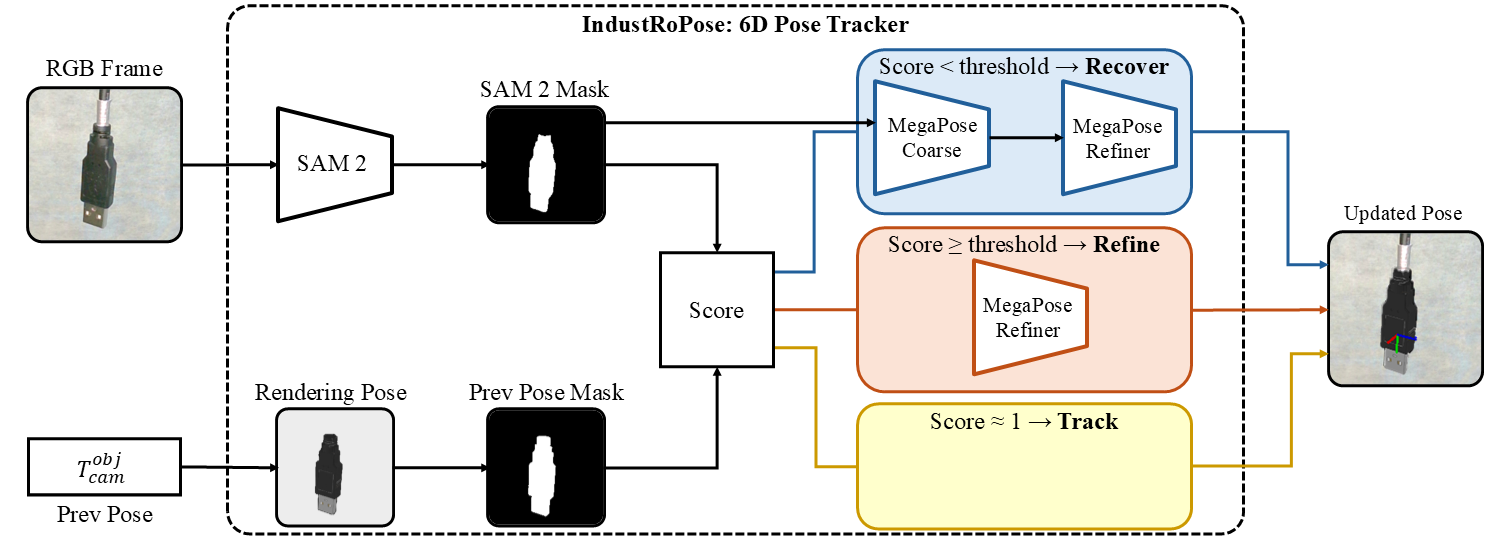
At the core of our system is IndustRoPose, a real-time 6D pose tracking pipeline designed for robust performance on streaming RGB input. It integrates the rapid zero-shot segmentation capability of SAM2 with the precise render-and-compare estimation of MegaPose.
How it works:
- Initialization: Before the stream begins, we initialize the system. SAM2 is given a pre-captured image and prompt points to automatically identify the target object. Simultaneously, MegaPose is loaded with the object's CAD model and camera intrinsic parameters.
- Tracking & Scoring: Once initialized, the system enters its tracking loop. At each timestep, it compares the current segmentation mask from SAM2 (the "ground truth") to a rendered mask from the previous pose estimate. We compute a "mask-consistency score" based on precision and recall to infer the tracking quality without running the expensive full pose estimation model every frame.
-
Adaptive Modes: This score dynamically triggers one of three modes:
- Track: If the score is high, we assume the previous pose is accurate and carry it forward.
- Refine: If the score is moderate (indicating minor drift), we trigger only the MegaPose refiner for a lightweight correction.
- Recover: If the score is low (due to occlusion or fast motion), we re-run the full coarse-to-fine estimation process to re-acquire the pose.
This adaptive strategy balances accuracy and computational efficiency, ensuring real-time performance (over 10 FPS) even under challenging conditions like occlusion, motion blur, or partial object visibility.
IndustRobot: Pose-Based Robotic Manipulation
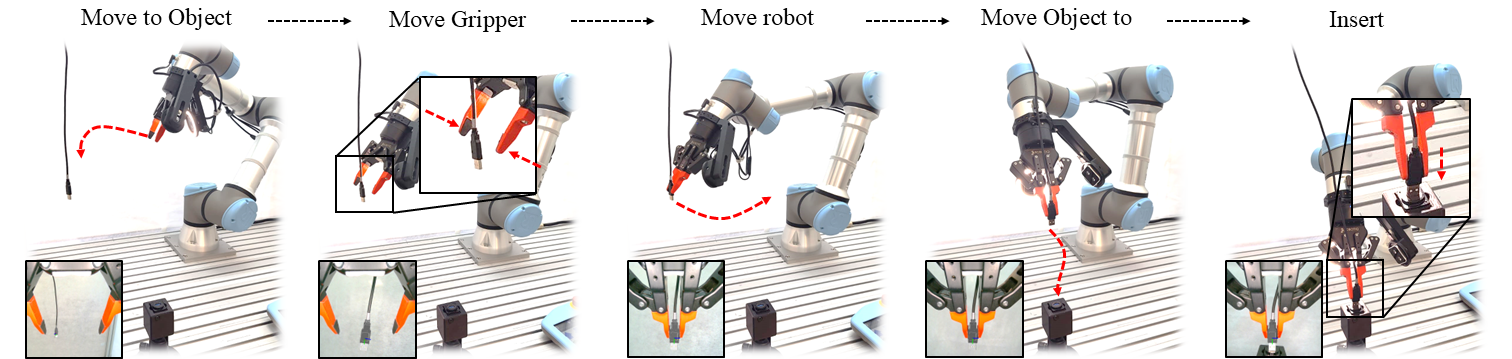
To address flexible and scalable automation, we present IndustRobot, a modular framework that integrates IndustRoPose's perception with a skill-based manipulation layer. To execute complex assembly tasks, we decompose the process into a sequence of modular and reusable skills that can be refined independently and recombined to solve new tasks. These skills, illustrated in the figure below, include:
- Move to Object: A pose-based skill using the IndustRoPose tracker to guide the gripper to the target object.
- Move Gripper: A low-level skill for force-controlled grasping.
- Move Object to: A pose-based skill to transport the grasped object to a target, also stabilized by the tracker.
- Insertion / Screwing: Advanced skills for the final, high-precision, contact-rich maneuvers.
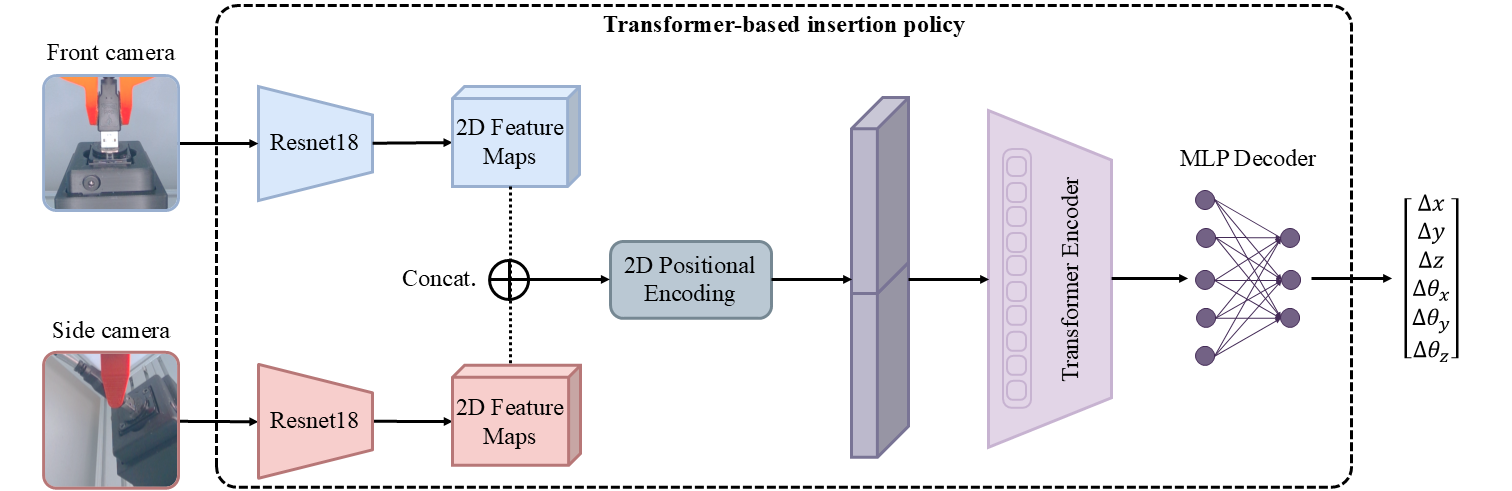
For precise, contact-rich skills like insertion, we use an advanced policy implemented using a transformer-based architecture. As shown in the next figure, it processes images from two cameras through ResNet18 encoders to extract feature maps. These are fed into a Transformer Encoder to find robust cross-view correspondences. Finally, an MLP decoder regresses the precise 6-DOF pose correction required for alignment.
Experiments
We evaluated our framework on two real-world tasks: plug insertion and screw driving, using a diverse set of standard industrial and consumer components.
Test Cases & Experimental Setup
To evaluate generality, we selected a diverse set of standard components. For plug assembly, this included USB (Types A, B, C), Ethernet (RJ45), Telephone (RJ11), and HDMI. The screwing task utilized M8 screws with Phillips (PH2, PH3) and Hex (HEX5, HEX6) drive types.

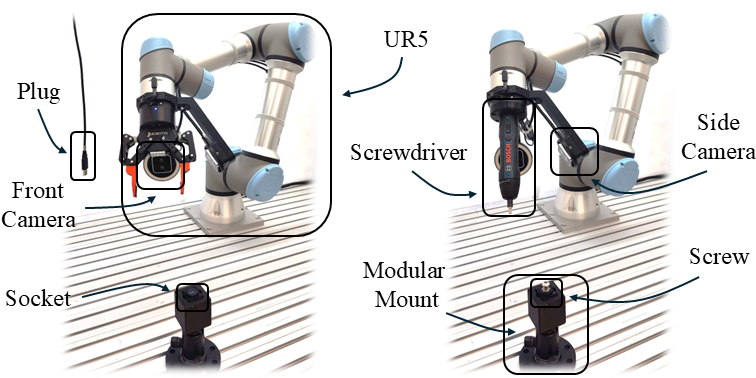
All experiments were conducted on a UR5e robotic arm in a controlled cell. The perception system consists of two Intel RealSense D405 cameras mounted on the robot's wrist. As shown in the figure, the end-effector was task-specific: a Robotiq 2F-85 adaptive gripper for plug insertion and a Bosch GO-2 electric screwdriver for screwing.
Success Rates
We achieved high success rates across all stages. For the plug assembly task, the full end-to-end pipeline success rate was 96.67% (58/60). For the screwing task, the full pipeline success rate was 97.50% (39/40), validating the robustness and modularity of our approach.
Plug Assembly Task
| Connector | Grasp | Align | Insert | Full pipeline |
|---|---|---|---|---|
| USB Type A | 100/100 | 100/100 | 97/100 | 10/10 |
| USB Type B | 99/100 | 100/100 | 99/100 | 10/10 |
| USB Type C | 99/100 | 100/100 | 99/100 | 10/10 |
| Ethernet RJ45 | 100/100 | 100/100 | 100/100 | 10/10 |
| Telephone RJ11 | 86/100 | 97/100 | 100/100 | 9/10 |
| HDMI | 100/100 | 100/100 | 92/100 | 9/10 |
| Total | 584/600 | 597/600 | 587/600 | 58/60 |
| Success Rate | 97.33% | 99.50% | 97.83% | 96.67% |
Screw/Unscrew Task
| Screw type | Align | Insert | Screw | Unscrew | Full pipeline |
|---|---|---|---|---|---|
| Philips PH2 | 99/100 | 100/100 | 50/50 | 50/50 | 10/10 |
| Philips PH3 | 100/100 | 100/100 | 50/50 | 49/50 | 10/10 |
| Allen HEX5 | 98/100 | 94/100 | 49/50 | 46/50 | 9/10 |
| Allen HEX6 | 95/100 | 98/100 | 48/50 | 50/50 | 10/10 |
| Total | 392/400 | 392/400 | 197/200 | 195/200 | 39/40 |
| Success Rate | 98.00% | 98.00% | 98.50% | 97.50% | 97.50% |
Grasping (Move to Object)
USB Type A
USB Type B
USB Type C
Ethernet RJ45
Insertion (Contact-Rich)
USB Type A
USB Type B
USB Type C
Ethernet RJ45
Screwing / Unscrewing
Philips PH2
Philips PH3
Allen HEX5
Allen HEX6